Wide range of web materials
Web Converting Machines
GFM builds and retrofits converting machines for almost any material that runs from a roll, from paper and nonwoven to film and laminates, each built around your material and product. Tell us what you want to produce and we will tell you whether it can be built, and how.
More than 40 years in converting machinery · More than 1,000 projects delivered worldwide · Engineered and made in Germany.
What Is Web Converting?
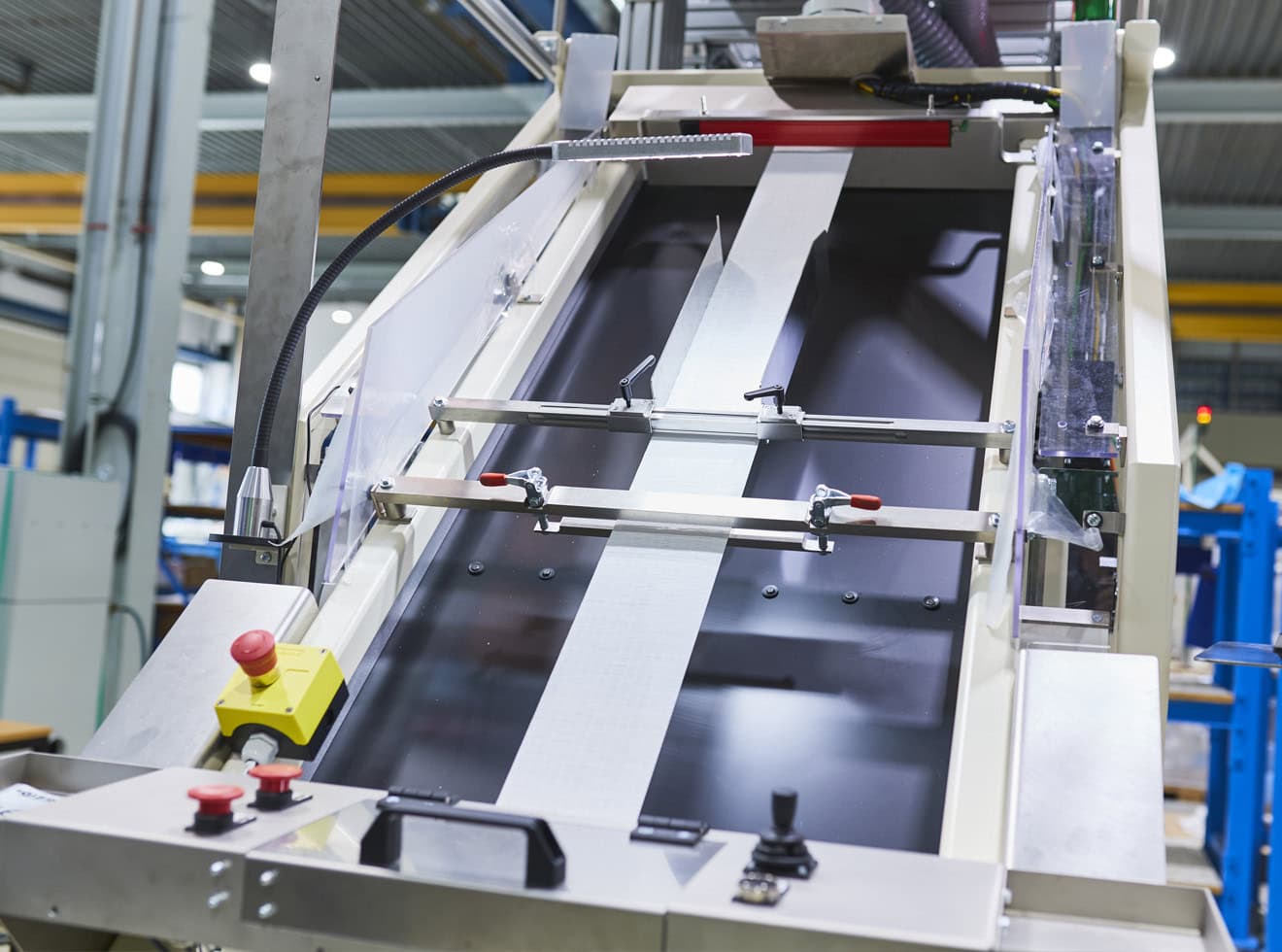
Web converting is the continuous processing of a running web, a long, flexible material fed from a roll. The web is unwound and guided under controlled tension, then run through the stations the product needs, such as slitting, laminating, die-cutting, perforating, folding or coating. From there it is rewound or finished into the end product. A web can be almost any flexible roll material, paper, nonwoven, film, textile or a technical web, and the material decides how it has to be guided and processed. That is why every line is designed around the material first, and from there it comes down to the specific product you make.
Web Converting and Web Handling Are Not the Same
Web handling is one module within the converting line, not a discipline of its own. We build and answer for the complete line, not only that module. Explore the modules.
Overview
Web Converting Equipment: The Range We Build Within
Different materials make very different demands on tension, guiding and cutting, so the right line depends on what you run. The figures here mark the range we build within, not a fixed boundary. If your material, web width or line speed falls outside them, or you are not sure, tell us and we will tell you what is feasible.
| Parameter | Range |
|---|---|
| Working width | up to 4,000 mm |
| Line speed | up to 400 m/min |
| Material thickness | 0.02 to 5 mm |
| Approvals | UL or CSA for North America, where required |
The Materials We Convert
Almost any material that runs from a roll can be web-converted, from thin film to lofty nonwoven, each handled according to how it behaves. These are some of the materials we build lines for, not a closed list.
Paper and Tissue
Converting lines for paper and tissue, from coffee filters to folded catering paper.
Nonwovens
Converting machinery for nonwovens in medical, hygiene and filtration products.
Films and Coated Webs
Plastic film and coated webs, slit, laminated and finished to size.
Other Web Materials
Fibre- and cellulose-based materials, textiles, laminates and composites, and technical web materials.
These are examples. If your material runs from a roll, it can most likely be converted; the question is how. We have built lines for a wide range of web materials, and even for technical components made from them, such as an automated production line for airbag cases. We test the feasibility of your specific material before you commit. Check feasibility.
Solutions Beyond the Standard
We build beyond the catalogue. When a standard machine cannot convert your web the way your product has to be made, we design the line around it: your material, your feature, your output. That covers a product with a feature no standard machine makes; a material that needs handling a standard line cannot give it; a hand-made product that has to go into series; or a line you already run that has to take on a new step.
The feature drives the machine. If your product depends on a particular cut, fold, bond or coating, we build the unit that makes it, rather than fit your product to a catalogue machine.
Retrofitting Existing Web Lines
Not every project starts with a new machine. A large part of our work is done on web lines that already run, often on lines we did not build. We bring an extra process step into a line that is otherwise sound, we convert a line to a new material or product, and we keep a line producing when its original manufacturer is gone. The mechanical interface is rarely the hard part. Getting the new module to work with your existing control system is what decides the effort and the schedule. More on maintenance, spare parts and retrofits under Service.
Industries
Medical
Surgical drapes, warming blankets and compresses from nonwoven webs.
Hygiene and Care
Wet wipes, towels, washing gloves and sponge cloths.
Filtration
Filter bags and nonwoven filter media for industrial and process filtration.
Food
Baking and greaseproof paper, absorbent pads and catering paper.
Sustainable Packaging
Plastic-free, multi-layer paper packaging bonded without adhesive.
Technical Web Products
Web materials converted into technical parts, up to fully automated component lines.
What decides whether we can help is not your industry but your product from the roll. If it runs from a roll, describe it.
Tell Us about Your Web Product
If your material or product is not shown above, describe it. Your enquiry reaches the engineers who build the machines, not a call centre, and we reply quickly.
FAQ: Web Converting Machines and Custom Lines
Single Module or a Complete Web Line?
Both. Each converting step is a self-contained module, so we can build a complete line from unwind to finished product, or a single module that drops into a line you already run. Because every station stands on its own, a single module can be added to a line you already have, rather than replacing the whole line. Tell us where you are, a new line or an extension, and we design to that.
Web Converting or Web Handling, What Is the Difference?
Web converting is the whole processing discipline, taking a material from the roll to a finished or semi-finished product through stations such as slitting, laminating, folding or coating. Web handling is one part of that, guiding and tensioning the web so it runs straight and flat at speed. A converting line contains web handling, not the other way round. We build the complete line and take responsibility for the whole process, not only the rollers or the controls.
What Materials Can Be Web-Converted?
The range is broad: paper and tissue, nonwovens, plastic film and coated webs, fibre- and cellulose-based materials, textiles, laminates and technical webs. What matters more than the list is that each behaves differently, so the web handling and the processing stations are set to the material, which is why two lines built for two materials can share very little. If you are unsure whether yours can be run, tell us about it and we will assess it before you commit.
A Full-Line Builder or a Web-Handling Component Supplier?
It depends on what you need. Component suppliers deliver rollers, tension controls or guiding systems that you or a third party integrate into a line. We deliver the line itself, from unwind to finished product, and answer for how the whole thing runs, web handling included. If you need a single component, a specialist supplier may be enough; if you need a line that holds tolerance across your material and your product, that is what we build.
Can You Retrofit a Web Line from Another Manufacturer?
Yes. A large part of our work is done on lines we did not build, including lines whose original manufacturer no longer exists. We first need access to the line and whatever documentation remains, and from there we assess what can be repaired, rebuilt, extended or replaced. The mechanical side is rarely the obstacle; getting a new module to work with your existing control system is usually what decides the effort, and it is often where a first project with us begins.
Where Do You Deliver, and How Does Service Work Worldwide?
We deliver worldwide, with more than 1,000 projects delivered to date, and every machine is installed and commissioned on site wherever it goes. After handover, service runs through remote diagnostics over a secured connection for anything that can be solved that way, and through a technician on site when it cannot. Genuine spare parts ship from Germany. For projects in North America we build to UL or CSA where the market requires it.
Tell Us What You Need to Produce
Describe your material, your product and the output you need. We will tell you whether it can be built, how, and roughly what it will cost before you commit to anything.
Let’s Talk about Your Web Product
Write to us and we will get back to you quickly.