Plastic film and coated webs
Film Converting Machines
GFM builds and retrofits converting machines for plastic film and coated webs, from a single module to a complete line, each built around your product rather than a standard machine. Tell us what you want to produce and we will tell you whether it can be built, and how.
More than 40 years in converting machinery · More than 1,000 projects delivered worldwide · Engineered and made in Germany.
Overview
Custom Film Converting Machines from GFM
Almost any plastic film or coated web can be converted, each with its own demands on tension, static and heat. We build the film converting equipment to match; the figures below are the range we build within, not a hard limit. If your film, web width or line speed sits outside them, or you are not sure, tell us and we will say what is feasible.
| Parameter | Range |
|---|---|
| Working width | up to 4,000 mm |
| Line speed | up to 400 m/min |
| Material thickness | from 0.02 mm |
| Approvals | UL or CSA for North America, where required |
Built for Thin Film That Stretches and Charges
Plastic film is thin and elastic. It stretches under tension and springs back, so too much tension distorts the register and the dimensions, and the web has to run at low, closely regulated tension. Film also carries a static charge, softens or shrinks under heat, blocks against itself on the roll and shows pinholes when it is thin.
Static control, a managed temperature window at every heated step, careful unwinding and inline inspection therefore belong in the line from the start, not as an afterthought. We build the web handling around that behaviour, with closely regulated tension, edge guiding and spreader rolls to hold the web flat and in register at speed. Get the handling right and the rest of the line does its work.
How We Build Your Film Converting Line
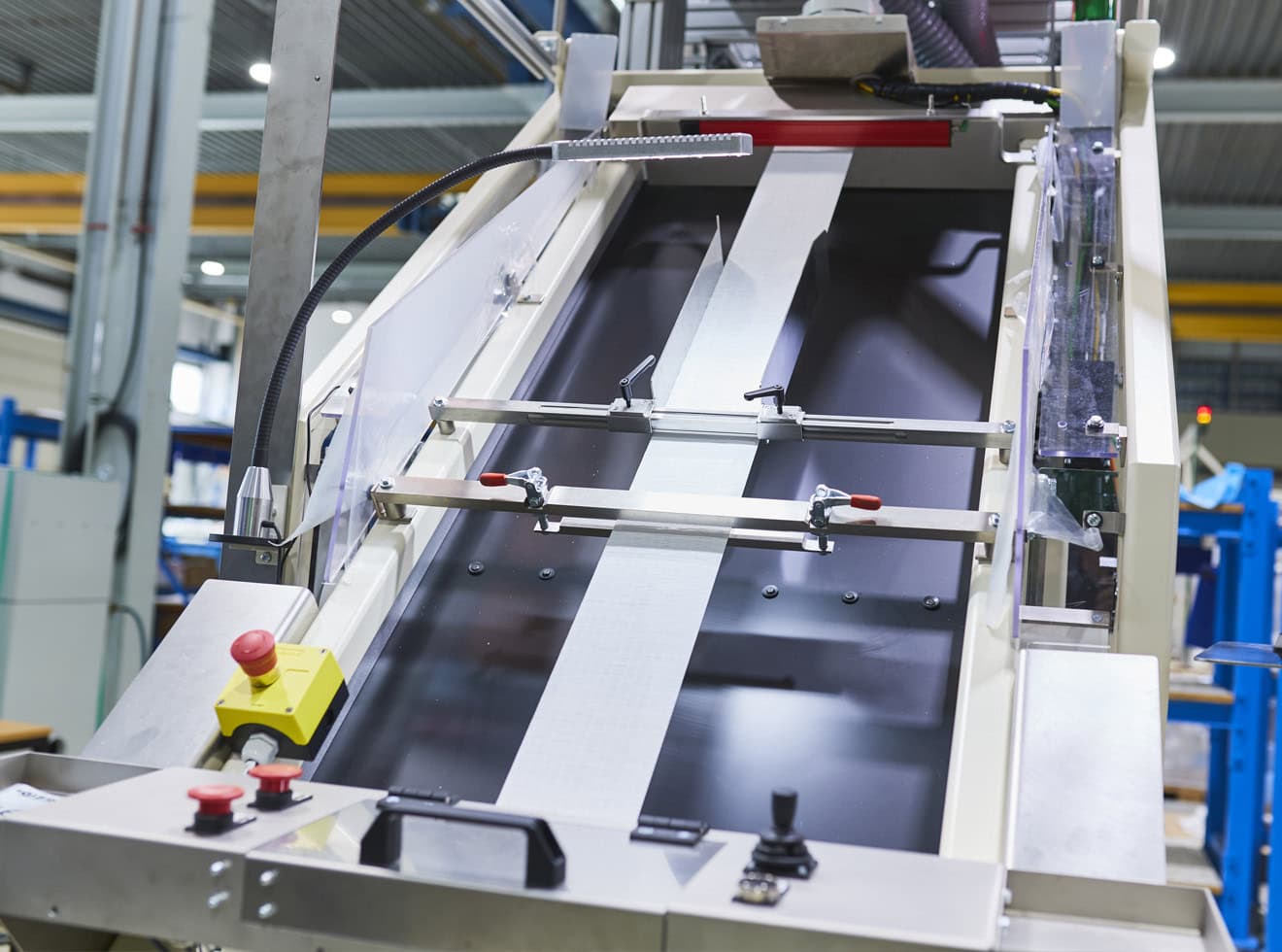
A film converting line is built from a set of modules, combined in the order your product needs. The roll is unwound, an autosplicer joins the next roll so the line keeps running, and the web is guided at low tension with edge guiding, spreader rolls and static control. From there it passes through the modules the product calls for: slitting, laminating for composite and barrier webs including intermittent lamination, coating and liquid application for coated webs, and perforating. Inline optical inspection runs before the web is rewound or finished. Because each module stands on its own, we can add one to a line that already runs rather than replace the line. Explore the modules.
Films and Coated Webs We Convert
We build across the range of plastic film work, from a single converting step to a complete line. These are the kinds of film we convert.
Barrier Films
Converting lines for barrier films, where tension, static and pinholing have to stay under control.
Laminated and Composite Films
Laminating film to film or film to paper for composite and multi-layer webs, including intermittent lamination.
Coated Webs
Coating and liquid application on film, with a managed temperature window for drying or curing where the line needs it.
Coextruded and Mono-Material Films
Converting coextruded and recyclable mono-material films without crushing or distorting the web.
These are categories, not a catalogue. Tell us your film and your product, and we will test the feasibility before you commit. Check feasibility.
Solutions Beyond the Standard
We build beyond the catalogue. When a standard machine cannot convert your film the way your product has to be made, we design the line around it: your material, your feature, your output. That covers a film product with a feature no standard machine makes; a barrier or composite web a standard slitter cannot make; a hand-made product that has to go into series; or a line you already run that has to take on a new step.
The feature drives the machine. If your product depends on a particular laminate, coating or cut, we build the unit that makes it, rather than fit your product to a catalogue machine.
Retrofitting Existing Film Converting Lines
Not every project starts with a new machine. A large part of our work is done on film converting lines that already run, often on lines we did not build. We bring an extra process step into a line that is otherwise sound, we convert a line to a new film or product, and we keep a line producing when its original manufacturer is gone. The mechanical interface is rarely the hard part. Getting the new module to work with your existing control system is what decides the effort and the schedule. More on maintenance, spare parts and retrofits under Service.
Industries
Films for Flexible and Barrier Packaging
Laminated, coated and barrier films, converted and finished to size.
Filtration
Film, coated and membrane media, converted and finished for filter elements.
Technical and Industrial Films
Film and coated webs converted for technical and industrial uses.
What decides whether we can help is not your industry but your film product. If it runs from a roll, describe it.
Tell Us about Your Film Product
If your film or product is not shown above, describe it. Your enquiry reaches the engineers who build the machines, not a call centre, and we reply quickly.
FAQ: Film Converting Machines and Custom Lines
What Is Film Converting?
Film converting is the processing of plastic film and coated or laminated webs from the roll into a finished or semi-finished product, through stations such as slitting, laminating, coating and perforating. We convert film, we do not make it: extrusion and casting sit upstream of us. The line starts from your roll and runs to your product.
Can a Line Run My Film Gauge and Width Without Stretching or Necking It?
Yes, that is what the web handling is built for. Because thin film is sensitive to tension, the line runs at low, closely regulated tension and holds the web flat across its width. The right settings depend on your film and your gauge, so tell us what you run and we will design the handling around it rather than force your film through a standard setup.
Can You Laminate or Coat Film for a Barrier or Composite Web?
Yes, laminating and coating are core to what we build, for composite, barrier and coated webs, including intermittent lamination and a managed temperature window where a heated step needs it. If your product is a multi-layer or barrier web rather than a single film, that is squarely the kind of line we design.
A Standard Film Slitter or a Custom Converting Line?
It depends on your product. A simple, standard job can run on a catalogue film slitter, and for that a specialist slitter supplier is the better fit. We come in when a standard machine cannot make your product the way it has to be made: a barrier or composite web, an unusual feature, a difficult film, or a line that has to take on a new step. If that is your case, a line built around your film and your product holds tolerance where a standard slitter cannot.
Can You Retrofit a Film Converting Line from Another Manufacturer?
Yes. A large part of our work is done on lines we did not build, including lines whose original manufacturer no longer exists. We first need access to the line and whatever documentation remains, and from there we assess what can be repaired, rebuilt, extended or replaced. The mechanical side is rarely the obstacle; getting a new module to work with your existing control system is usually what decides the effort, and it is often where a first project with us begins.
Where Do You Deliver, and How Does Service Work Worldwide?
We deliver worldwide, with more than 1,000 projects delivered to date, and every machine is installed and commissioned on site wherever it goes. After handover, service runs through remote diagnostics over a secured connection for anything that can be solved that way, and through a technician on site when it cannot. Genuine spare parts ship from Germany. For projects in North America we build to UL or CSA where the market requires it.
Tell Us What You Need to Produce
Describe your film, your product and the output you need. We will tell you whether it can be built, how, and roughly what it will cost before you commit to anything.
Let’s Talk about Your Film Product
Write to us and we will get back to you quickly.