Custom Converting Machines for Web and Roll Materials
Customers turn to GFM when no one else can build the machine. We design and build custom converting machines beyond the standard, for web and roll materials: from a single handling or processing module in an existing line to a complete turnkey line that runs from the roll to the finished product.
Tell us what you want to produce and we will tell you whether it can be built, and how.
More than 40 Years
Four decades in converting machinery, which is why most of what your line needs we have built before in another form.
More than 1,000 Projects
Delivered across Europe, Asia and the Americas, from a single module in a mid-sized plant to a complete line for a corporate group.
Made in Germany
Development, design and manufacturing under one roof at a single site. The engineers who design your line are the people who build it.
One Supplier
Engineering, build, installation, commissioning, training and spare parts. Coordinating between suppliers is our job, not yours.
Converting Machines Built Around Your Product
Three questions decide whether we are the right partner for your line. Here are the answers on one screen.
Materials
GFM builds machinery for web and roll materials, from single handling and processing modules to complete lines. What matters more than the material name is how the web behaves as it runs.
- Nonwovens
- Paper and tissue
- Films and coated webs
- Fibre- and cellulose-based materials
- Textiles
- Laminates and composites
- Technical web materials
Processes
A converting line combines the steps your product needs, in the order it needs them.
- Unwinding, rewinding and autosplicing
- Slitting and cross cutting
- Folding: cross, longitudinal and side-push
- Laminating, embossing and perforating
- Sealing and liquid application
- Web handling and tension control
Scope of Supply
We come in wherever your project starts, from one module to a complete line.
- A single module for a line you already run
- A retrofit or conversion of an existing line
- A section of a line
- A complete turnkey installation
| Parameter | Range |
|---|---|
| Working width | up to 4,000 mm |
| Line speed | up to 400 m/min |
| Material thickness | 0.02 to 5 mm |
Rather Talk It Through?
Call us and describe your application. You reach the people who build the machines, not a call centre.
Standard Machine or Custom Converting Line?
| A standard machine is the right answer when | A custom line is the right answer when |
|---|---|
| your product matches an established format | your product has a feature no catalogue machine produces |
| the volumes justify a catalogue solution | the material behaves in a way a standard line cannot cope with |
| the product is unlikely to change much | an existing line has to be extended or converted |
| you are buying a commodity | the original manufacturer is gone and no one supports the line |
| an existing machine already makes something close enough | the product is still made by hand and has to go into series production |
The dividing line is easy to state. With a standard machine you adapt your product to the machine. With a custom line the machine is built around your product. For a commodity, that trade-off is reasonable. For a product you differentiate on, it is not.
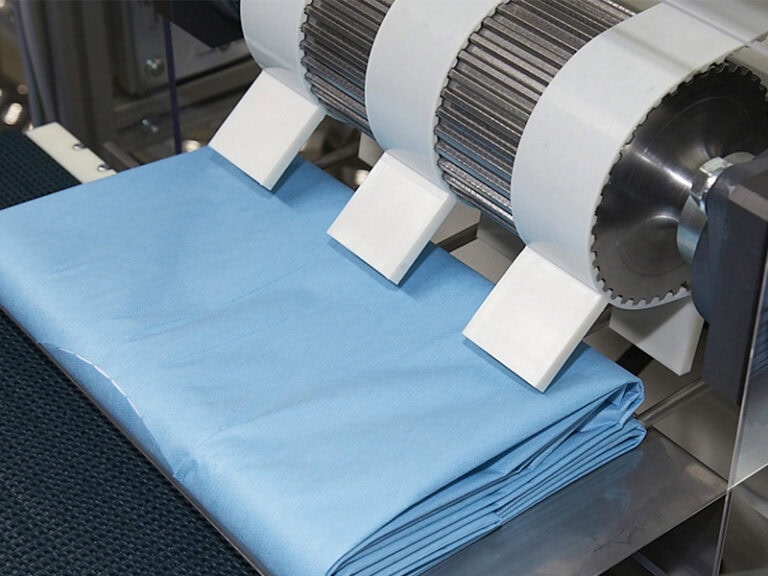
An example from medical devices makes it concrete. A surgical drape has to come out of its pack with one hand, without breaking sterility. That single requirement dictates the fold pattern, and the fold pattern dictates the folding unit. No catalogue machine makes that fold, which is why the line has to be designed around it.
From the Roll to the Finished Product
Each stage feeds the next, planned and built by one supplier.
Unwinding and Web Handling
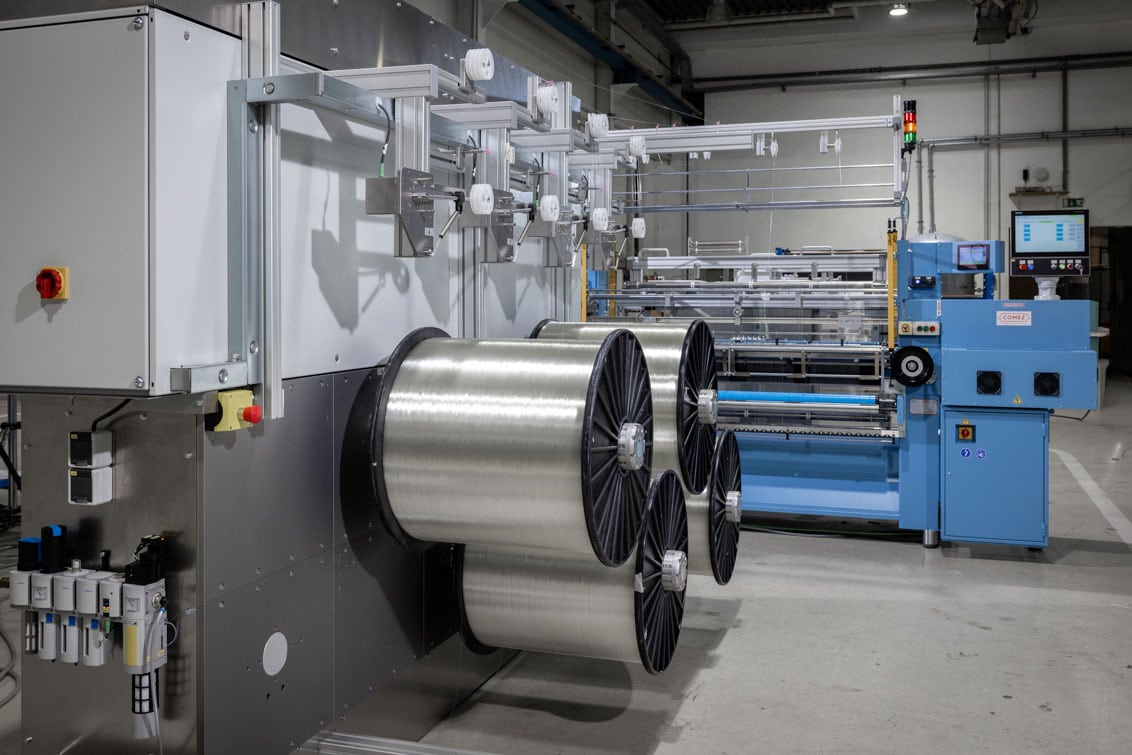
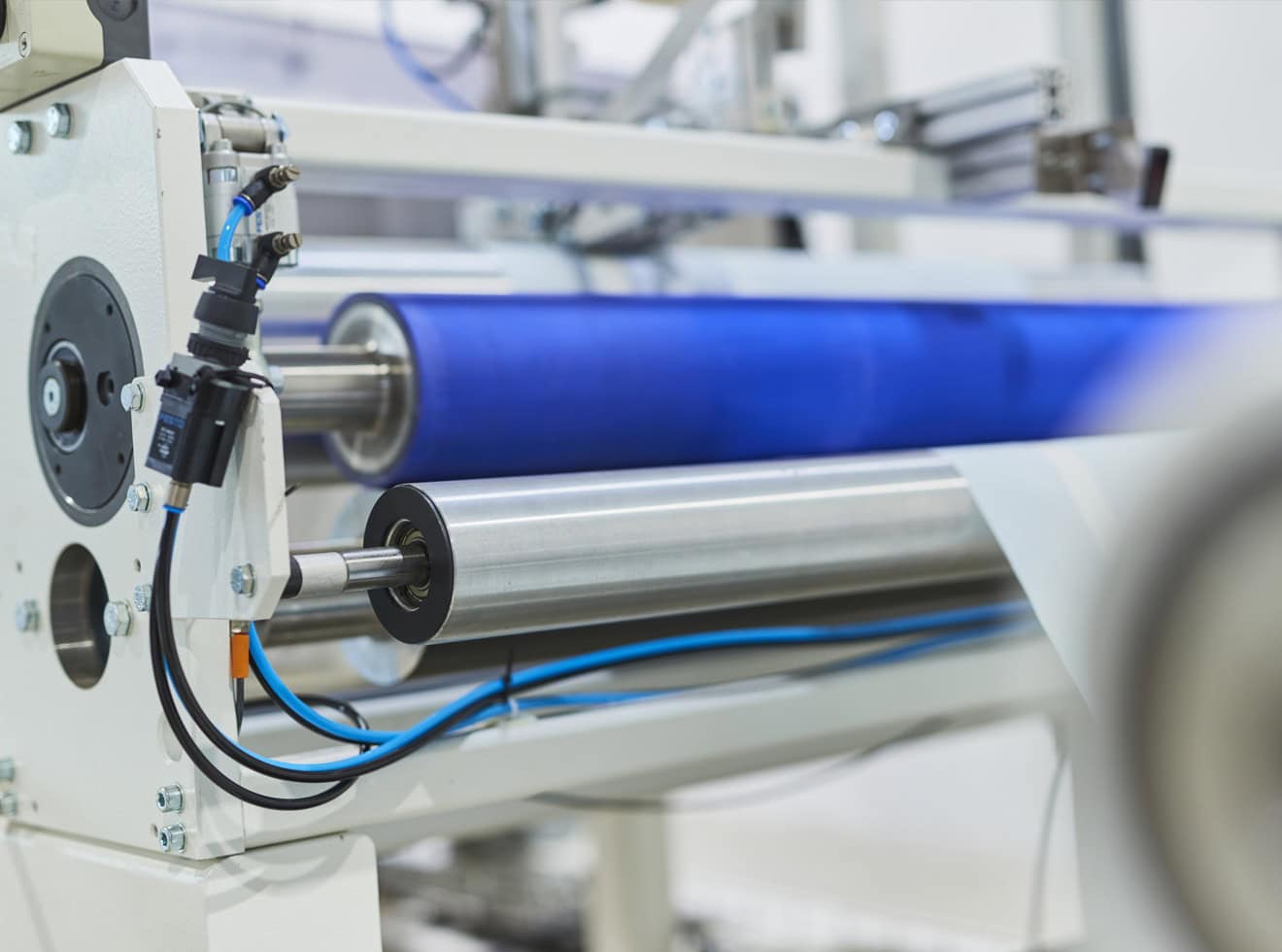
Precise from the first metre: the roll is unwound, aligned and held at constant tension while it runs, and an autosplicer joins the next roll to the running web so production does not stop for a roll change. Tension control, edge guiding and spreader rolls keep the web flat and in register. This stage decides whether the line holds its tolerances at speed.
Processing: the Stations That Do the Work
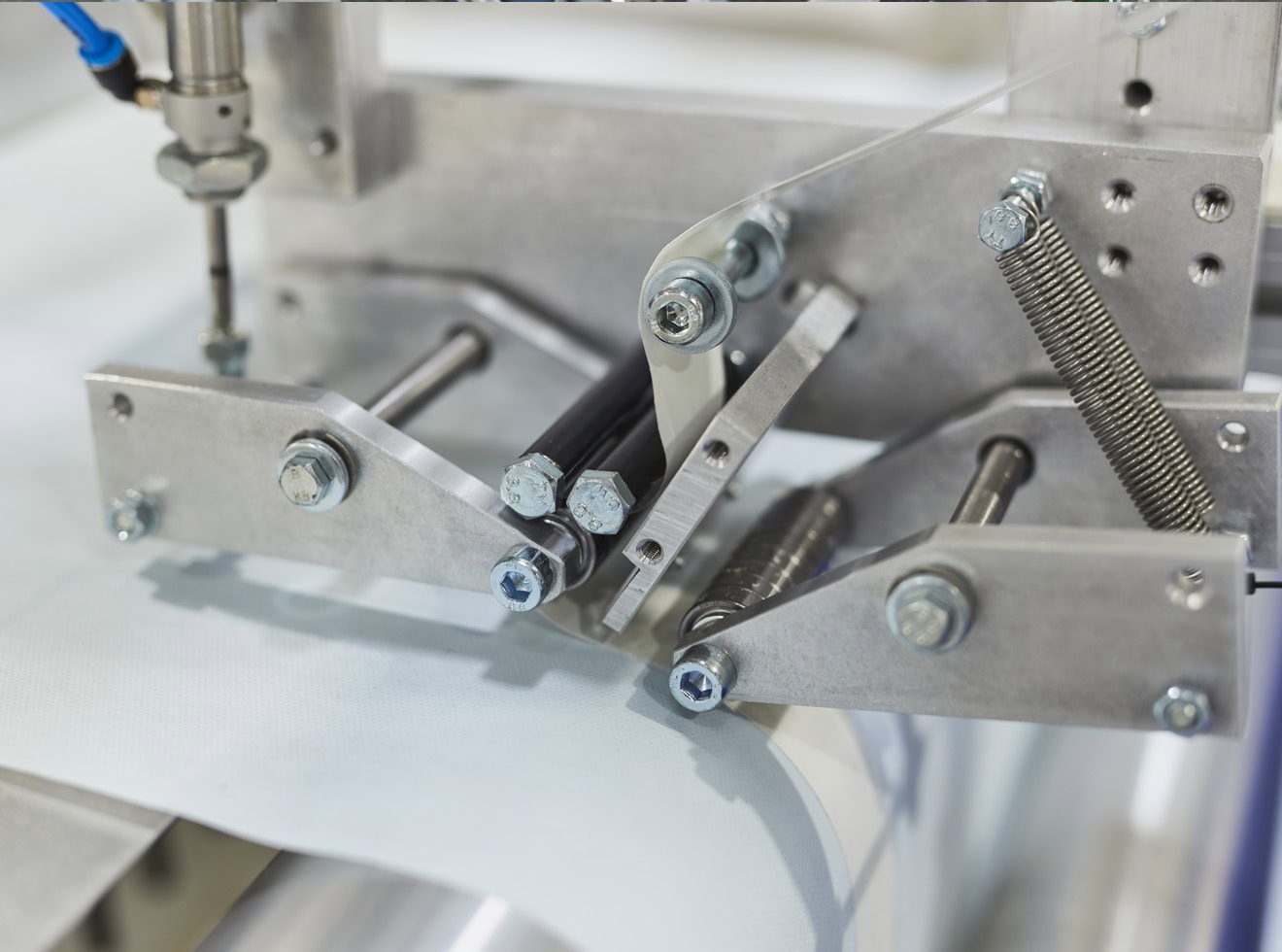
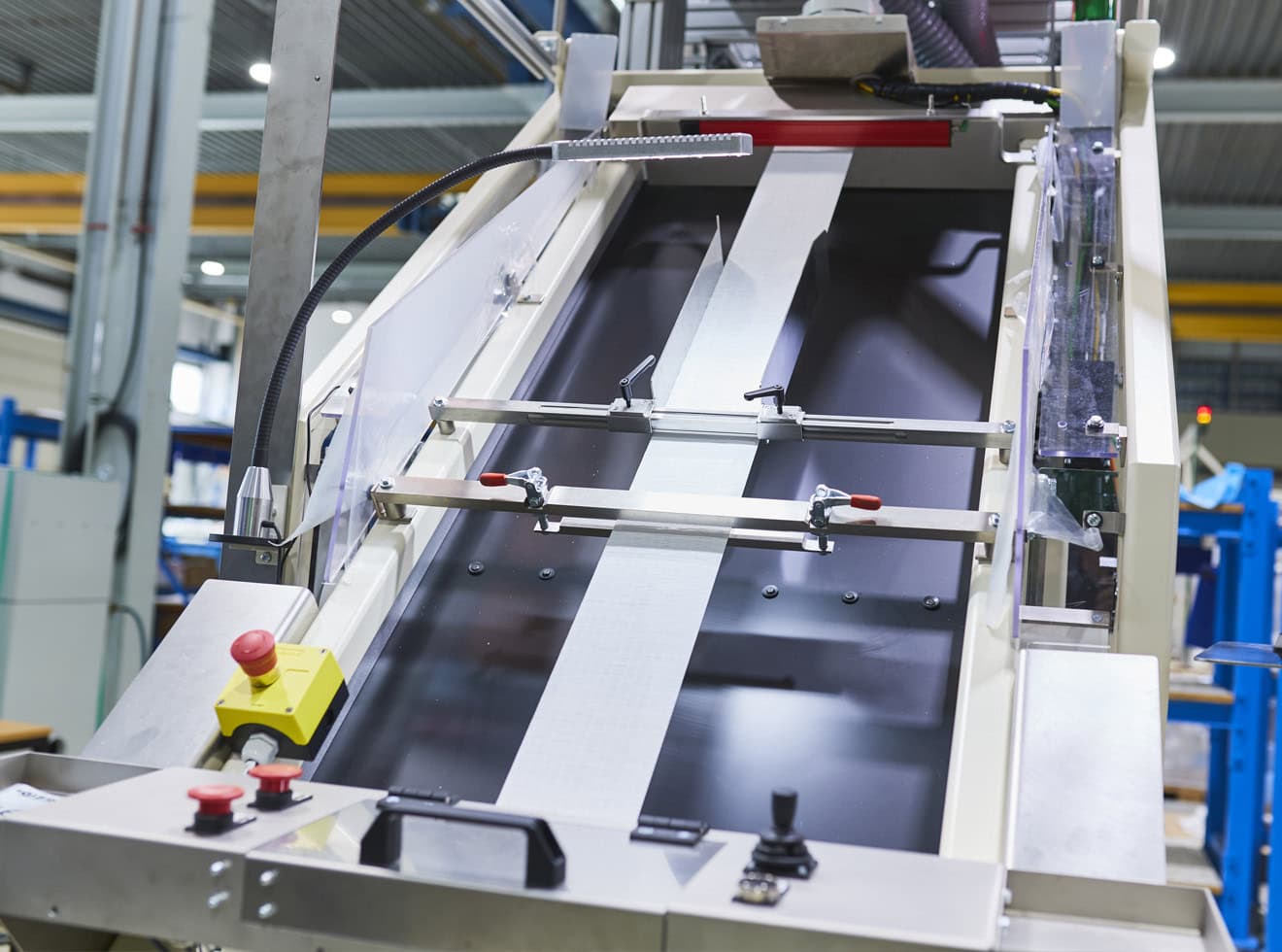
The heart of the line: the stations that shape the product. Which of them a line needs, and in which order they sit, is dictated entirely by your product. That sequence is the reason two lines for two similar products are rarely the same machine, and it is the part we engineer from scratch each time. Each station is also a module in its own right, which is why we can add one to a line that already runs. Explore the modules.
Finishing and Transfer to Packing
Ready for despatch: the product is counted, stacked, folded into its final form and passed to packing. Inline optical inspection takes faulty products out before they get that far. When we build the full line, what leaves it is the finished product, ready for sterilisation, packaging or shipping. When your project is a single module, it slots into the stage of your line where it is needed.
Why Manufacturers Choose GFM
GFM is the specialist for custom converting machines beyond the standard. For over 40 years we have built special-purpose machinery for the automated processing of web and roll materials, with more than 1,000 projects delivered worldwide. GFM is a member of the VDMA, the German Engineering Federation.
A Specialist, Not an All-Rounder
Converting machinery for web and roll materials is the whole of what we do, which is why you spend the first meeting on your product instead of explaining your process.
Feasibility First
Before anything is quoted we establish whether what you need can be built, and how. We say no when it cannot, which is rare, and early enough to save you time.
Proven Solutions, Not Experiments
More than 40 years in the same niche means we are not researching from scratch for every enquiry. That is what keeps the surprises out of commissioning.
One Supplier, End to End
Engineering, build, installation, commissioning, operator training and spare parts, with one contact for the whole project.
Engineered and Made in Germany
One site for development, design and manufacturing, so a change during the build does not travel through three companies.
In Service Worldwide
Machines running at leading international manufacturers in medical devices, hygiene and filtration, across Europe, Asia and the Americas.
Converting for Medical Devices, Hygiene, Filtration and Food
The quickest way to judge whether we understand your process is to look at what our machines already produce.
Medical Devices
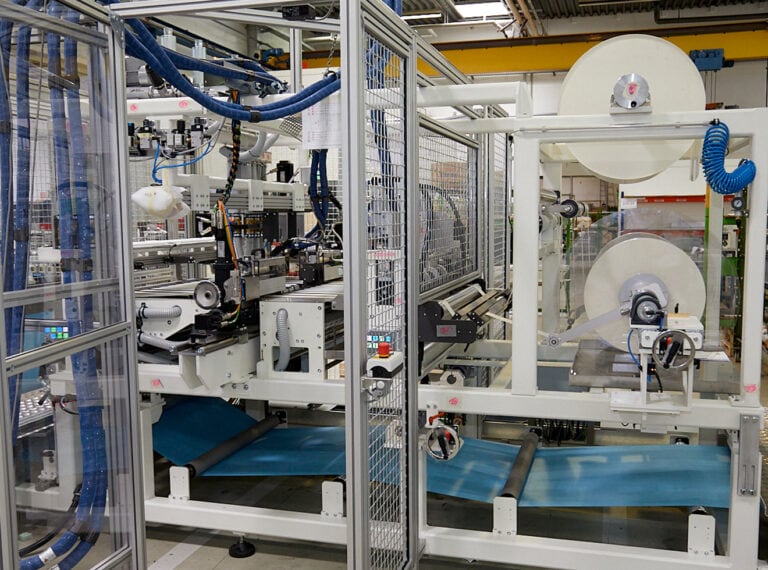
We build lines for surgical drapes with sterile one-handed fold patterns, patient warming blankets, nonwoven compresses and examination gowns.
Hygiene and Care
Our machines make washing gloves, headrest covers, sponge cloths, dry and paper towels and vacuum cleaner bags, with cartoning integrated where it makes sense.
Filtration
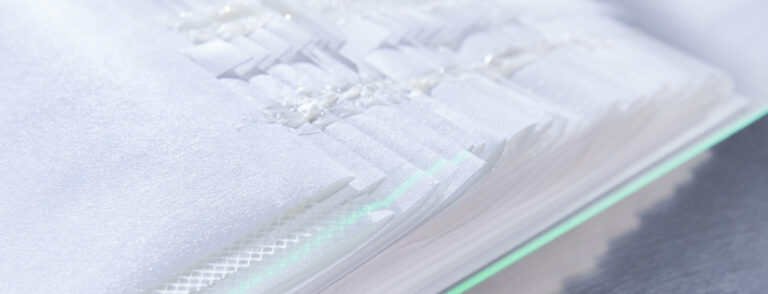
We build spiral winding lines for membrane elements, filter bag production and winding technology for gas filtration.
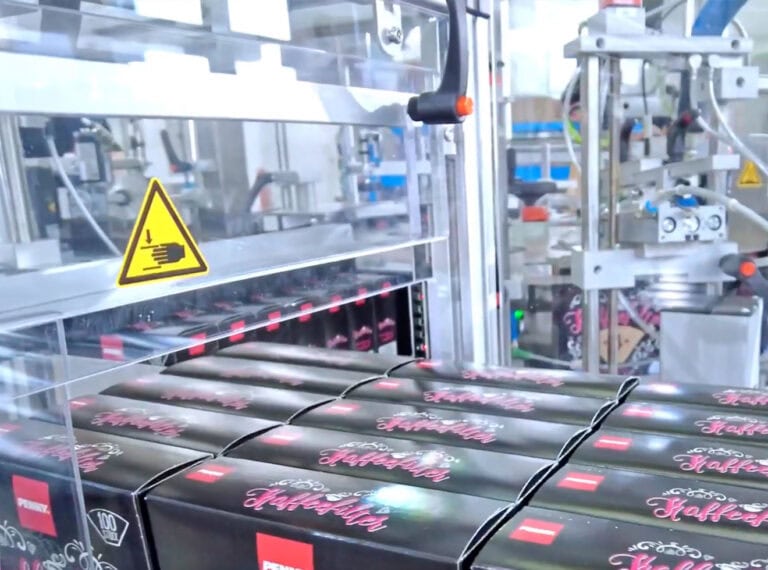
Food
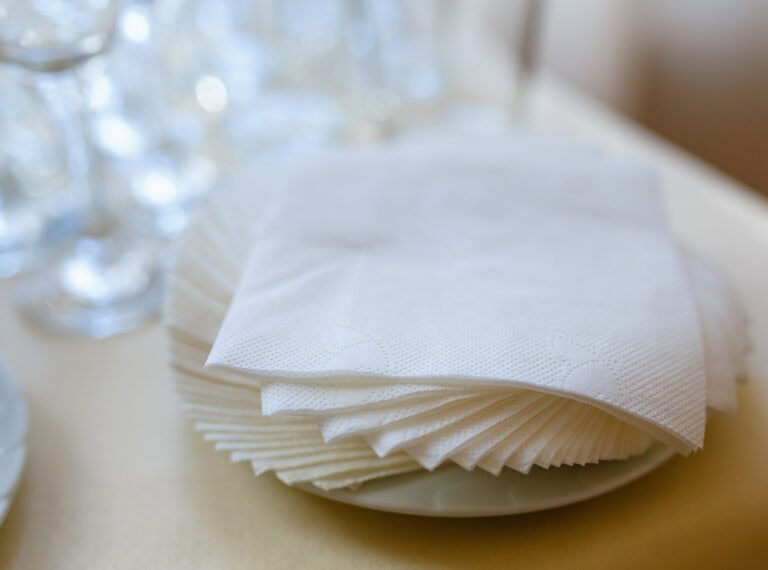
Our lines produce coffee filters, baking and greaseproof paper, absorbent pads for thermoformed trays and disposable catering products. We build the machines, not the food.
Sustainable Packaging
Knurling bonds multiple layers of paper by embossing, with no plastic and little or no adhesive.
What decides whether we can help is not your industry but your product. If it is made from web or roll material, describe it.
Converting Lines We Have Built
Every line below was built for one customer and one product. They are the most direct answer we can give to the question of whether something can be built, because they are running.
Paper Converting Machine
Paper web to finished product in one continuous pass.
PE Gown Manufacturing Line
Fully automated production of disposable protective gowns.
Automatic Production Line for Airbag Cases
Web material processed and assembled into a technical component, outside the disposables field.
Semi-Automatic Permeate Tube Winding System
Winding technology for membrane filter elements.
Fully Automated Patient Warming Blanket Production Line
Multi-layer medical product, produced and finished inline.
Coffee Filter Production Machine
From paper reel to finished coffee filter, at volume.
Our machines in use at:
- Arrow International
- Arizant Healthcare
- Bastos Viegas
- Betatex
- Cardiva Integral Solutions
- Drylock Technologies
- EVONIK Industries
- Georgia-Pacific
- Paul Hartmann
- ITS Foil, Film & Paper Products
- Johnson & Johnson
- Kimberly Clark
- KONOS
- The Surgical Company
- Mölnlycke Health Care
- 3M Group
- SCA Hygiene Products
- Sengewald Klinikprodukte
- Tentok Corporation
- ZHENDE MEDICAL CO. LTD
Get in touch with us.
We’ll find the ideal solution for your application!
Upgrading an Existing Line, Whoever Built It
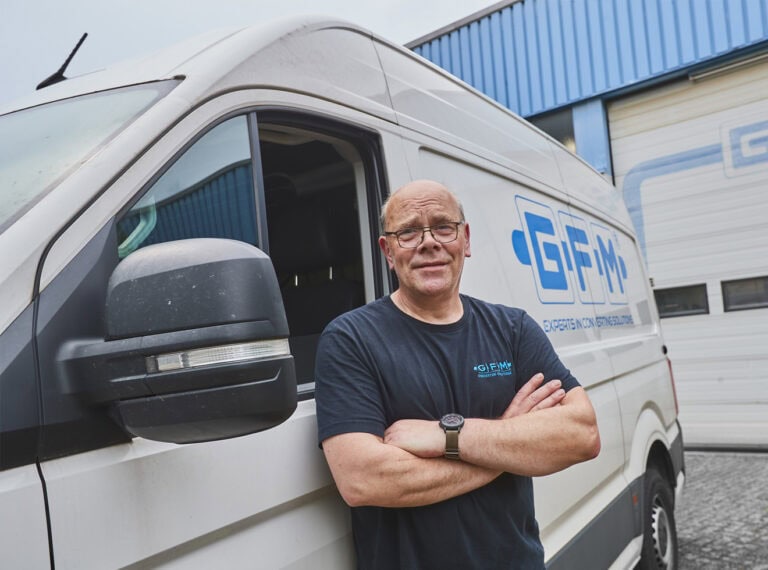
Not every project starts with a new machine. A large part of our work is done on lines that are already running, often on lines we did not build.
- Adding a process step. A perforating unit, an inline slitting module or an additional folding station brought into a line that is otherwise fine. The mechanical interface is the easy part. Getting the new module to talk to your existing control system is what decides the effort and the schedule.
- Converting a line to a new product. The line is sound, the product has changed, and the question is how much of the existing machine can stay.
- Keeping a line alive when its manufacturer is gone. Whatever the reason, you still have a machine that has to produce tomorrow morning. We regularly take on other manufacturers’ lines in exactly these situations.
From Enquiry to Running Line
1. Feasibility
You tell us the product, the material, the output you need and what you already have on the shop floor, whether that is an existing line or people doing the work by hand. No finished specification required.
2. Concept and Budget
You have a concept and a budget figure in front of you before engineering starts. If the investment does not work out at that point, it is far better to know then than after six months of design work.
3. Engineering and Design Review
Our engineers work in parallel with your product development where that speeds things up. Nothing gets built until you have signed off the design.
4. Commissioning, Training and After-Sales
Installation and commissioning at your site, training for the people who will run the machine, genuine spare parts, and remote diagnostics for whatever can be solved without a flight.
Depending on the size of the project, a line runs from order to production in roughly six to eighteen months.
FAQ: Converting Machines and Custom Lines
What Is a Converting Machine?
A converting machine processes web material supplied on a roll, such as paper, tissue, nonwoven or film, into a semi-finished or finished product. It unwinds the roll, guides the web through a sequence of processing stations such as slitting, folding, laminating, embossing or sealing, and delivers either a new roll, a sheet or a finished, ready-to-ship product.
What Is Converting in Manufacturing?
Converting is the production step between making a material and packing the finished goods. The raw web is made first, on a paper machine, a nonwoven line or an extruder; converting then turns that web into a usable product by cutting it to size, folding it, bonding layers, embossing or sealing it. It is a discipline of its own, distinct from making the material and distinct from packaging machinery.
What Is the Difference Between a Standard Converting Machine and a Custom-Built Line?
Converting machine manufacturers who sell from a catalogue build to a fixed format, so your product has to fit what the machine already does. A custom line is designed around your product, your material and the output you need, which means the sequence of processing stations is worked out for your case rather than picked from a list. The practical test is whether any catalogue machine produces the feature your product depends on. If one does, a standard machine is the cheaper route and we will say so. If none does, there is no standard route.
Can You Help with a Machine Another Manufacturer Built?
Yes. We regularly work on lines we did not build, including cases where the original manufacturer no longer exists and there is nobody left to call. What we need first is access to the machine and whatever documentation survived, and from there we can judge what can be repaired, rebuilt or replaced. This is often how a first project with us begins: someone has a line that has to keep producing and no supplier left to support it.
What Do You Need from Me to Assess Feasibility?
Four things, and none of them require a finished specification. What the product is, ideally with a sample. What material it is made from. How much of it you need per hour or per shift. And what you already have on the shop floor, whether that is an existing line, a single machine or people doing the work by hand. With that we can usually tell you whether what you need can be built, and roughly how, which is the question most people want answered before anything else.
Where Do You Deliver, and How Does Service Work at a Distance?
We have delivered more than 1,000 projects across Europe, Asia and the Americas, and every machine is installed and commissioned on site wherever it goes. After handover, service runs through remote diagnostics over a secured connection for anything that can be solved that way, and through a technician on site when it cannot. Genuine spare parts ship from Germany the same day for orders placed before 2 pm. For projects in North America we build to UL or CSA where required.
Tell Us What You Need to Produce
Describe your product, your material and the output you need. We will tell you whether it can be built, how, and roughly what it will cost before you commit to anything.
Let’s Talk about Your Product
Write to us and we will get back to you quickly.